The Modernist Art Critic Clement Greenberg Coint the Term
| Clement Greenberg | |
|---|---|
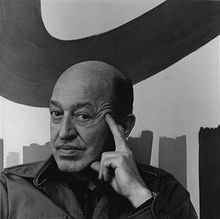 | |
| Born | Clement Greenberg (1909-01-16)January 16, 1909 New York City, New York, U.Southward. |
| Died | May 7, 1994(1994-05-07) (aged 85) New York Metropolis, New York, U.Southward. |
| Nationality | American |
| Educational activity | Syracuse Academy (AB) |
| Movement |
|
Clement Greenberg () (January sixteen, 1909 – May vii, 1994),[1] occasionally writing under the pseudonym K. Hardesh, was an American essayist known mainly equally a very influential visual art critic closely associated with American Mod fine art of the mid-20th century and a Formalist aesthetician. He is all-time remembered for his clan with the art movement Abstract Expressionism and the painter Jackson Pollock.
Early life [edit]
Clement Greenberg was born in the borough of the Bronx, NYC, in 1909. His parents were center-class Jewish immigrants, and he was the eldest of their three sons. Since childhood, Greenberg sketched compulsively, until condign a immature adult, when he began to focus on literature. Greenberg attended Erasmus Hall High School, the Marquand School for Boys, and so Syracuse Academy, graduating with an A.B. in 1930, cum laude, Phi Beta Kappa.[two] Later on college, already as fluent in Yiddish and English language since childhood, Greenberg taught himself Italian and German in addition to French and Latin. During the next few years, Greenberg travelled the U.S. working for his father's dry-appurtenances business, but the piece of work did non suit his inclinations, so he turned to working as a translator. Greenberg married in 1934, had a son the adjacent year, and was divorced the year after that. In 1936, Greenberg took a series of jobs with the federal government, from Civil Service Assistants, to the Veterans' Administration, and finally to the Appraisers' Division of the Community Service in 1937. Information technology was then that Greenberg began to write seriously, and soon after began getting published in a handful of pocket-size magazines and literary journals.[3]
"Advanced and Kitsch" [edit]
Though his first published essays dealt mainly with literature and theatre, art still held a powerful attraction for Greenberg, so in 1939, he fabricated a sudden name as a visual art author with possibly his most well-known and oft-quoted essay, "Avant-garde and Kitsch", first published in the journal Partisan Review. In this Marxist-influenced essay, Greenberg claimed that truthful avant-garde art is a product of the Enlightenment'southward revolution of critical thinking, and as such resists and recoils from the degradation of civilization in both mainstream backer and communist society, while acknowledging the paradox that, at the aforementioned time, the artist, dependent on the market or the state, remains inexorably fastened "past an umbilical cord of gilt". Kitsch, on the other hand, was the product of industrialization and the urbanization of the working form, a filler made for the consumption of the working course: a populace hungry for culture, simply without the resources and pedagogy to enjoy cutting edge avant garde culture. Greenberg writes,
Kitsch, using for raw material the debased and academicized simulacra of 18-carat culture, welcomes and cultivates this insensibility. It is the source of its profits. Kitsch is mechanical and operates by formulas. Kitsch is vicarious experience and faked sensations. Kitsch changes according to style, just remains always the aforementioned. Kitsch is the paradigm of all that is spurious in the life of our times. Kitsch pretends to demand nothing of its customers except their money – non even their time."[4]
For Greenberg, avant garde art was too "innocent" to be effectively used as propaganda or aptitude to a cause, while kitsch was ideal for stirring up false sentiment.
Greenberg appropriated the German language discussion "kitsch" to draw this low, concocted form of "culture", though its connotations take since been recast to a more affirmative acceptance of nostalgic materials of capitalist/communist culture.
Art history, Abstract Expressionism and later [edit]
Greenberg wrote several seminal essays that divers his views on art history in the 20th century.
In 1940, Greenberg joined Partisan Review as an editor. He became art critic for the Nation in 1942. He was associate editor of Commentary from 1945 until 1957.[5]
In Dec 1950, he joined the government funded American Commission for Cultural Freedom. Greenberg believed Modernism provided a critical commentary on experience. It was constantly changing to adapt to kitsch pseudo-culture, which was itself ever developing. In the years subsequently Earth War 2, Greenberg pushed the position that the best advanced artists were emerging in America rather than Europe.[half dozen] Particularly, he championed Jackson Pollock as the greatest painter of his generation, commemorating the artist's "all-over" gestural canvases. In the 1955 essay "American-Type Painting" Greenberg promoted the work of Abstruse Expressionists, among them Jackson Pollock, Willem de Kooning, Hans Hofmann, Barnett Newman, and Clyfford Nonetheless, as the side by side stage in Modernist fine art, arguing that these painters were moving towards greater emphasis on the 'flatness' of the film plane.
Greenberg helped to articulate a concept of medium specificity. It posited that there were inherent qualities specific to each dissimilar artistic medium, and part of the Modernist projection involved creating artworks that were more and more committed to their item medium. In the example of painting, the 2-dimensional reality of their medium led to an increasing emphasis on flatness, in contrast with the illusion of depth commonly found in painting since the Renaissance and the invention of pictorial perspective.
In Greenberg's view, later on World War 2 the Us had become the guardian of 'avant-garde art'. He praised like movements abroad and, afterwards the success of the Painters Eleven exhibition in 1956 with the American Abstract Artists at New York'due south Riverside Gallery, he travelled to Toronto to run into the group's work in 1957. He was particularly impressed past the potential of painters William Ronald and Jack Bush, and subsequently developed a close friendship with Bush. Greenberg saw Bush-league'southward post-Painters Eleven work as a clear manifestation of the shift from abstract expressionism to Colour Field painting and Lyrical Brainchild, a shift he had called for in most of his critical writings of the period.
Greenberg expressed mixed feelings about popular fine art. On the i mitt he maintained that pop fine art partook of a trend toward "openness and clarity as confronting the turgidities of second generation Abstract Expressionism." Just on the other hand Greenberg claimed that popular art did not "really challenge taste on more than a superficial level." [vii]
Through the 1960s Greenberg remained an influential figure on a younger generation of critics including Michael Fried and Rosalind Eastward. Krauss. Greenberg's antagonism to 'Postmodernist' theories and socially engaged movements in art caused him to go a target for critics who labelled him, and the art he admired, equally "onetime fashioned".
In his book "The Painted Give-and-take", Tom Wolfe criticized Greenberg forth with Harold Rosenberg and Leo Steinberg, whom he dubbed the kings of "Cultureburg". Wolfe argued that these three critics were dominating the world of fine art with their theories and that, unlike the world of literature in which anyone can buy a book, the fine art world was controlled by an insular circle of rich collectors, museums and critics with out-sized influence.[viii]
Mail service-painterly brainchild [edit]
Eventually, Greenberg was concerned that some Abstract Expressionism had been "reduced to a set of mannerisms" and increasingly looked to a new set of artists who abased such elements as bailiwick matter, connection with the artist, and definite brush strokes. Greenberg suggested this process attained a level of "purity" (a word he only used within scare quotes) that would reveal the truthfulness of the canvas, and the two-dimensional aspects of the infinite (flatness). Greenberg coined the term Mail-Painterly Abstraction to distinguish it from Abstract Expressionism, or Painterly Abstraction, as Greenberg preferred to telephone call it. Mail-Painterly Abstraction was a term given to a myriad of abstruse art that reacted against gestural abstraction of second-generation Abstract Expressionists. Among the dominant trends in the Mail-Painterly Abstraction are Hard-Edged Painters such every bit Ellsworth Kelly and Frank Stella who explored relationships between tightly ruled shapes and edges, in Stella's case, betwixt the shapes depicted on the surface and the literal shape of the support and Color-Field Painters such every bit Helen Frankenthaler and Morris Louis, who stained first Magna then water-based acrylic paints into unprimed canvas, exploring tactile and optical aspects of large, bright fields of pure, open color. The line between these movements is tenuous, still equally artists such as Kenneth Noland utilized aspects of both movements in his fine art. Post-Painterly Abstraction is by and large seen as continuing the Modernist dialectic of self-criticism.
Clement Greenberg Collection [edit]
In 2000, the Portland Art Museum (PAM) acquired the Clement Greenberg Drove of 159 paintings, prints, drawings, and sculpture past 59 of import artists of the late-20th century and early-21st century. PAM exhibits the works primarily in the Jubitz Center for Modern and Contemporary Art – some sculpture resides outdoors. Nearly of the artists represented are American, along with several Canadians, and a handful of artists of other nationalities. Artists represented in the drove include amidst others: Edward Avedisian, Walter Darby Bannard, Stanley Boxer, Jack Bush-league, Anthony Caro, Dan Christensen, Ronald Davis, Richard Diebenkorn, Enrico Donati, Friedel Dzubas, André Fauteux, Paul Feeley, Helen Frankenthaler, Robert Goodnough, Adolph Gottlieb, Hans Hofmann, Wolfgang Hollegha, Robert Jacobsen, Paul Jenkins, Seymour Lipton, Georges Mathieu, Kenneth Noland, Jules Olitski, William Perehudoff, Jackson Pollock, Larry Poons, William Ronald, Anne Ryan, David Smith, Theodoros Stamos, Anne Truitt, Alfred Wallis, and Larry Zox.[9]
Greenberg's widow, Janice van Horne, donated his annotated library of exhibition catalogues and publications on artists in Greenberg's drove to the Portland Art Museum.[10] Greenberg'due south annotated library is available at the Portland Art Museum'southward Crumpacker Family Library which is open to the public free of charge.
In popular civilisation [edit]
Greenberg was portrayed by actor Jeffrey Tambor in the 2000 film Pollock, well-nigh the life of Jackson Pollock.
Bibliography [edit]
- Greenberg, Clement. Art and Culture, Buoy Press, 1961
- Greenberg, Clement. Late Writings, edited by Robert C. Morgan, St. Paul: Academy of Minnesota Press, 2003.
- Cloudless Greenberg: A Critic's Drove past Bruce Guenther, Karen Wilkin (Editor), Portland: Portland Art Museum, 2001. (ISBN 0-691-09049-1)
- Greenberg, Clement. Homemade Esthetics: Observations on Art and Gustation. Oxford University Press, 1999.
- Jones, Caroline A. Eyesight Lonely: Cloudless Greenberg'south Modernism and the Bureaucratization of the Senses. University of Chicago Printing, 2005.
- Kuspit, Donald. Cloudless Greenberg: Art Critic. University of Wisconsin, 1979.
- Marquis, Alice Goldfarb. Art Arbiter: The Ascension and Fall of Clement Greenberg. Boston: MFA Publications, 2006.
- O'Brian, John. Cloudless Greenberg: The Collected Essays and Criticism. iv vols. Chicago: University of Chicago Printing, 1986 and 1993.
- Rubenfeld, Florence. Cloudless Greenberg: A Life. Scribner, 1997.
- Tekiner, Deniz. "Formalist Fine art Criticism and the Politics of Significant." Social Justice, Issue on Art, Power, and Social Change, 33:two (2006).
- Anatoly Rykov. Clement Greenberg and American theory of gimmicky art in the 1960s, in Art History, Periodical of the Russian Constitute of Art History. 2007, no. 1-two, pp. 538–563.
See also [edit]
- Art criticism
- Art critic
- Fine art history
- Modernism
- Ceremonial (art)
- Postmodern art
- Abstruse Expressionism
- Mail-Painterly Abstraction
- Color Field
- Lyrical Brainchild
- American Abstruse Artists
- Jackson Pollock
- Willem de Kooning
- Painters Eleven
- Medium specificity
References [edit]
- ^ "Greenberg". Random Business firm Webster's Unabridged Dictionary.
- ^ Alice Goldfarb Marquis, "Fine art Czar: The Rise and Autumn of Clement Greenberg", MFA Publications, Boston, 2006, pp. 7–9, 12–13
- ^ Greenberg, Clement (1995). "Autobiographical Argument". The Collected Essays and Criticism, Book 3: Affirmations and Refusals, 1950–1956. Chicago: Academy of Chicago Printing. p. 195. ISBN0226306232.
- ^ Greenberg, Clement. "Avant-Garde and Kitsch." Partisan Review. half dozen:5 (1939) 34–49
- ^ Roger Kimball, Collected Essays and Criticism, by Cloudless Greenberg, edited by John O'Brian [ permanent dead link ] , Commentary, December 1987
- ^ Frances Stonor Saunders, The Cultural Cold War: The CIA and the Globe of Arts and Messages, New York: The New Printing, 1999, pp. 158, 199, 255, 258, 275, 277.
- ^ "Post Painterly Abstraction". www.sharecom.ca . Retrieved 8 Apr 2018.
- ^ Davis, Douglas (June 9, 1975). "Crying Wolfe". Newsweek 88. In Shomette 1992.
- ^ Clement Greenberg: A Critic's Collection by Bruce Guenther, Karen Wilkin (Editor) (ISBN 0-691-09049-one)
- ^ "FindArticles.com - CBSi". findarticles.com . Retrieved viii April 2018.
External links [edit]
- Cloudless Greenberg – Writer page that includes text of many works by Greenberg
- Clement Greenberg – Art Critic on The Art Story Foundation website
- Finding aid for Clement Greenberg papers, 1928–1995 The Getty Enquiry Institute, Los Angeles, California.
Source: https://en.wikipedia.org/wiki/Clement_Greenberg
0 Response to "The Modernist Art Critic Clement Greenberg Coint the Term"
Post a Comment