What Art Is With a Lot of Circles and Black and White

"Cutting Ribbon, Man In Wheelchair, Paintings (Version #2), 1988" shows John Baldessari's signature technique, faces covered with colorful circles. The practice had its genesis when the creative person idly stuck a price sticker on the face of someone pictured in a newspaper clipping. Courtesy the artist/John Baldessari Studio hide caption
toggle explanation
Courtesy the artist/John Baldessari Studio
At that place are certain creations that have defined beauty for generations: Renoir'south pudgy, pink nude; Rothko's bright blocks of color that seem to vibrate; Michelangelo's naked young homo in marble, with a slingshot on his shoulder.
In Venice, Calif., 81-yr-old artist John Baldessari respects these definitions — and then turns them upside down. Baldessari is an icon in some art circles, particularly in Southern California. Six-foot-vii, with long white pilus and a beard, he's been called "a towering figure." Thoughtful and provocative, he has burned his ain paintings, put colored dots over faces in photographs, and covered floors at the Los Angeles Canton Museum with a rug of blue sky and puffy white clouds.
Lots of times, a Baldessari makes you smile, then go ... "Huh?" In his sunny studio, the creative person says he's trying to slow usa downwardly, to look in new means.
"You know, when yous're sitting in a dentist office or physician's role, and you expect in a magazine and, and you go, 'What was that?' I would like people to have that feeling, you lot know, that, 'Look, what did I just see?' " Baldessari says with a laugh.
Similar with the colored dots pasted onto photographs — they're actually toll stickers. Over the years he'd been collecting black-and-white news images — pictures of people at various borough occasions.
"I just got so tired of looking at these faces," Baldessari says — faces of mayors shaking hands with firefighters, faces of local officials at ribbon-cut ceremonies.
In 1985, in a fit of pique, Baldessari covered the faces with colored dots.
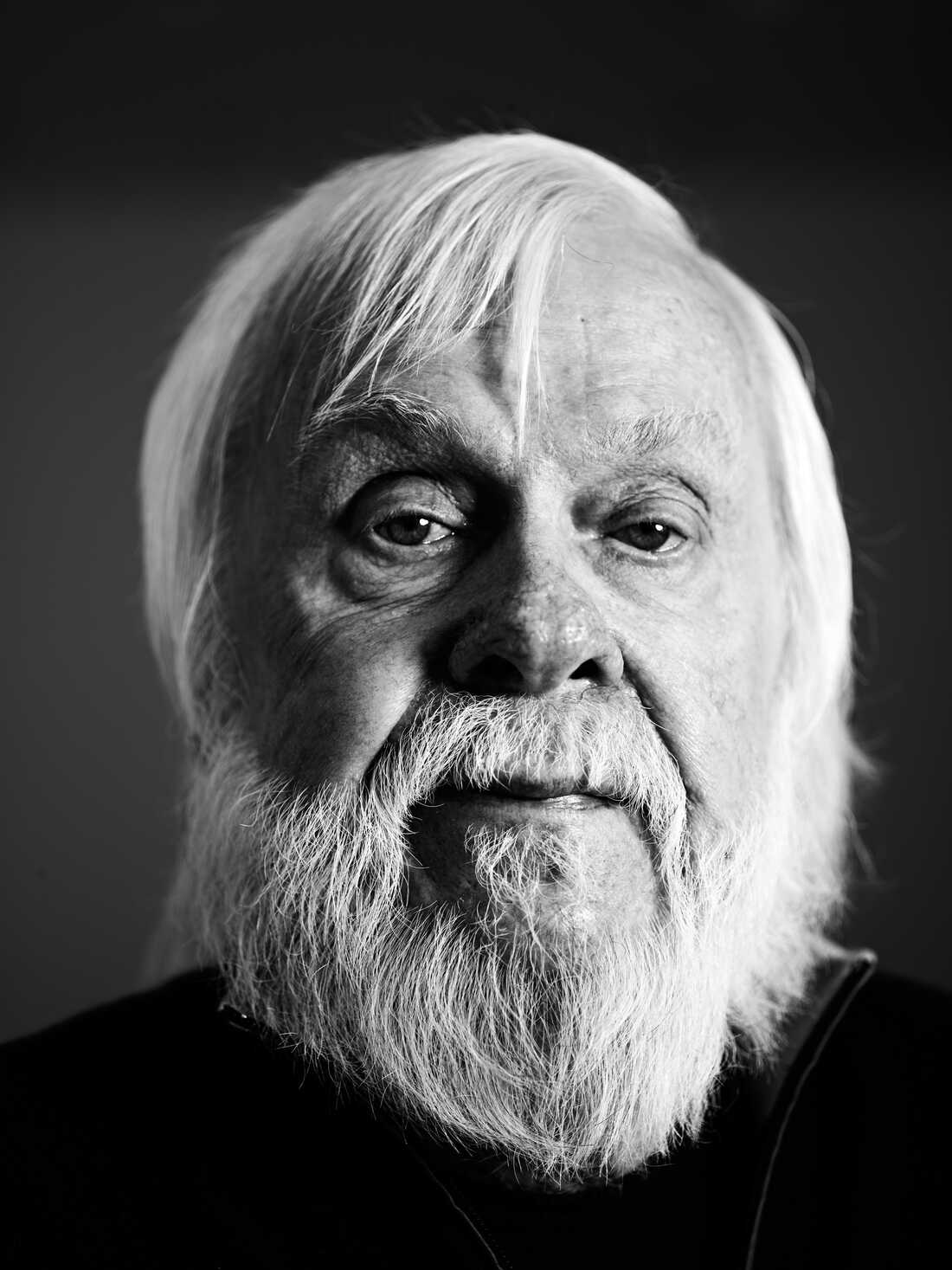
In 1970, John Baldessari burned everything he had painted between 1953 and 1966. "I said ... 'I don't really need them.' Then I decided I'll just destroy them." After that, Baldessari turned to photography and sculpture. Hedi Slimane/Courtesy the creative person hide explanation
toggle caption
Hedi Slimane/Courtesy the artist
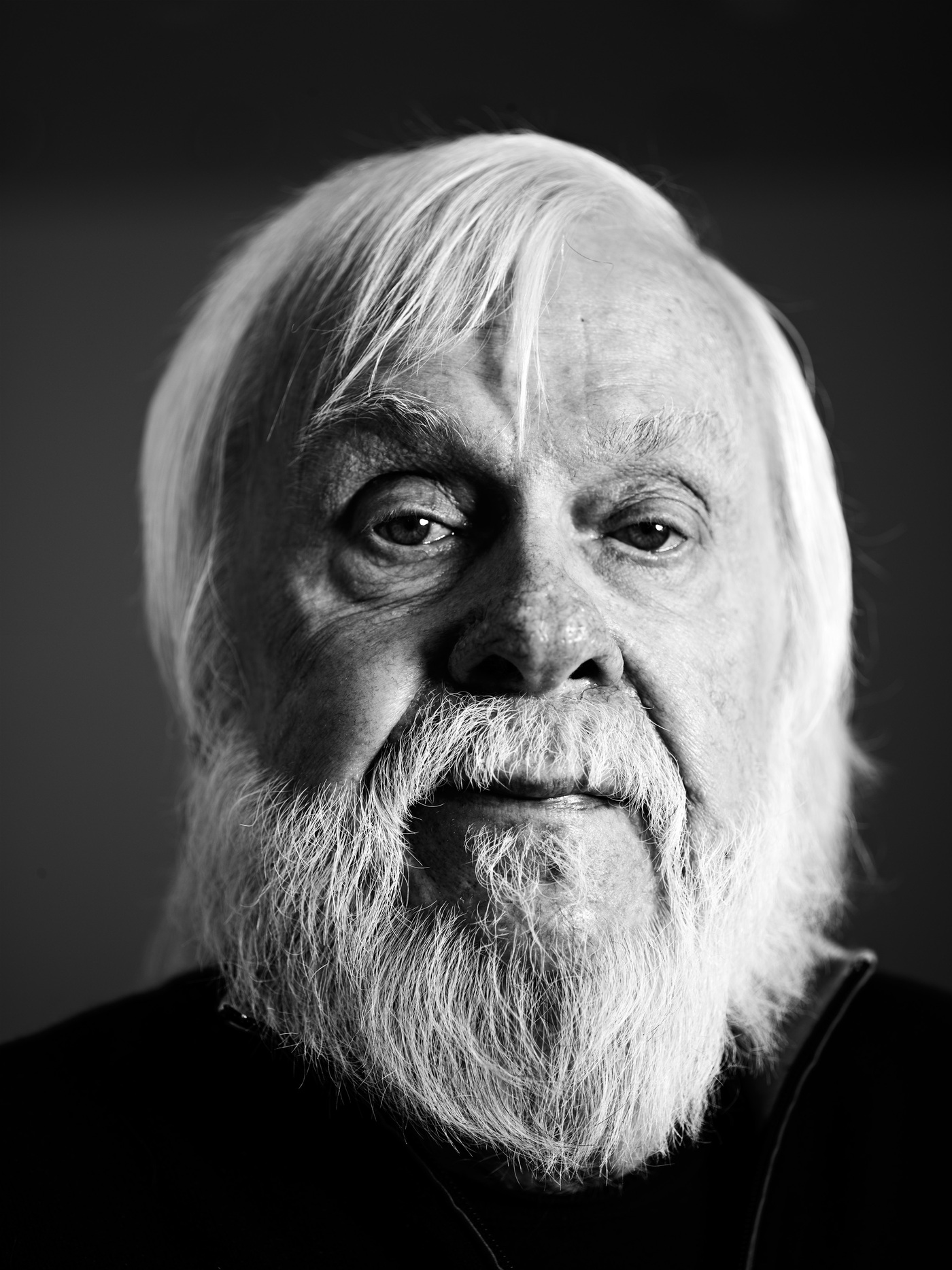
In 1970, John Baldessari burned everything he had painted between 1953 and 1966. "I said ... 'I don't actually need them.' So I decided I'll just destroy them." Afterwards that, Baldessari turned to photography and sculpture.
Hedi Slimane/Courtesy the creative person
"If you tin can't meet their confront, yous're going to look at how they're dressed, maybe their stance, their surroundings," he explains. "You actually practise come across that handshake. You know, it's non near those guys, it'south well-nigh that handshake. It's about cutting that ribbon."
But aren't the human faces the virtually interesting part? Why leave a viewer with but mundane objects — scissors and a slice of ribbon?
"Why do I leave it? Because I — I retrieve y'all really sort of dig beneath the surface and yous tin can see what that photo is really virtually, what's going on," says Baldessari.
Michael Govan, manager of the Los Angeles Canton Museum of Art (LACMA), understands.
"If yous obliterate the face up, then you brainstorm to run across the easily and the ribbon as full of meaning," Govan says, "because no two ribbons, no two easily, no 2 ceremonies are the same."
In Govan's listen, that specific device — the colored dots — speaks to Baldessari's technique more generally: "Sometimes he takes away the thing that's most obvious in the center of your vision, forces you to await at everything else, almost for the get-go fourth dimension, to brand new sense of what yous're seeing."
Govan calls Baldessari "one of the almost influential artists working today," a pioneer of "conceptual fine art," where it'due south the idea that counts — the idea in the artist'south caput that becomes art in the heads of viewers equally they try to puzzle it out.
LACMA curator Leslie Jones says Baldessari chews up the familiar and spits information technology out into something else.
"I've oftentimes thought of Baldessari'due south work equally kind of a surrealism for the media age, if that makes sense," Jones says, "because he'due south taking pre-existing imagery and reconfiguring it and creating new realities, or surrealities ... from them."
In 1970, Baldessari was painting in San Diego and, he says, getting nowhere. He had no gallery, no audience and no buyers for his pictures.
"And so I said, 'Well, I'm simply going to stop. I have them in my head. I don't really need them,' " he says. "Then I decided I'll just destroy them."
He took everything he'd painted from 1953 to 1966, constitute a mortuary and cremated all of information technology. Burned his body of piece of work. 9-and-a-half boxes of ashes later on, he still has no regrets about losing whatever of them. It was a ritual deed of purification. A farewell to the tradition of painting. And a rebirth for him. He turned to photography as his main medium of expression and communication — the modern medium, Baldessari believes.
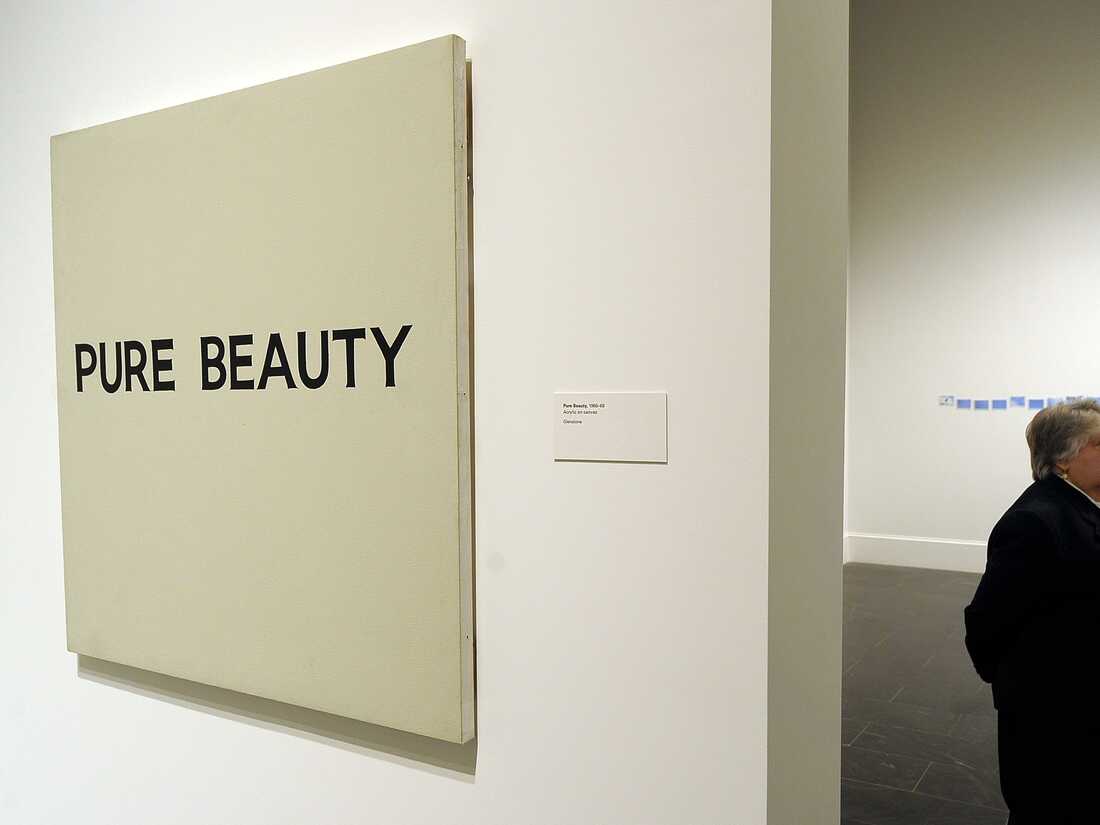
"Pure Dazzler," shown here at the Metropolitan Museum of Art in New York in 2010, is one of John Baldessari'south many provocative "text paintings." Timothy A. Clary/AFP/Getty hide caption
toggle caption
Timothy A. Clary/AFP/Getty
He did relieve some "text paintings," though. He was experimenting with using words in his work, and "Pure Beauty" is 1 case. Those ii words, in black capital messages, on a painted white canvas. Jones, who curated a Baldessari show called "Pure Dazzler," says he was, again, trying to get us to recall.
"What is pure dazzler? And ultimately, pure beauty is a very subjective experience," says Jones. "You know, it could be a painting by Rothko. It could be about color, it could be about a beautiful landscape. Simply ultimately, everyone's notion of pure dazzler is different. So, for me, this work is carrying that very idea, is that pure beauty is whatever you want to envision in your head."
Govan says that from childhood on, we're taught certain standards of dazzler.
"You lot know something'due south beautiful because somebody'southward told yous it'southward beautiful, and then you'll use that as the definition," he says. "John's trying to unmake that elementary reference, that information technology's cute because somebody else says it's beautiful, and wants you to recall well-nigh it. What are the constructs of beauty?"
And then, just two unproblematic words on a sheet ... that can be pure beauty. Information technology'southward funny, this stuff. Makes you laugh — at get-go.
"I would say that John's work possesses something like deep humor," Govan reflects. "Information technology's funny, but ... it leads you lot somewhere. It's never a 1-liner that ends there. It's e'er based on some deep philosophy, consideration, afterthought, manner of seeing. Information technology'southward never just funny for the sake of being funny."
Baldessari finds humor — in his work and in this earth. Awhile ago, one of his text paintings sold for $4.4 million.
"You but have to laugh," he says. "It's my life. It'south what I do. ... I suspect it'due south, y'all know, by keeping my mind agile, information technology'southward keeping me, you know, alive."
A smile, a farewell handshake, and John Baldessari gets dorsum to work.
Watch A Cursory History of John Baldessari, directed by Henry Joost and Ariel Schulman and narrated by Tom Waits.
YouTube
Source: https://www.npr.org/2013/03/11/173745543/for-john-baldessari-conceptual-art-means-serious-mischief
0 Response to "What Art Is With a Lot of Circles and Black and White"
Post a Comment